
Conway, AR · Garage Door Service
What Happens When a Spring Goes in Cold Weather in Conway
Most Conway homes went up between 1972 and 2003, and cold snaps push aging torsion springs past their limit. Here's what's actually happening and what to check.
- Repairs & new doors
- Springs & openers
- Serving 4 nearby communities
What Is Going On
Steel contracts when it gets cold, and a torsion spring that's already wound tight to hold a door's weight has less give left when the metal shrinks. That's the mechanical part. The local part is the age of what's hanging in these garages. Housing across the Conway area was mostly built between 1972 and 2003, with the bulk of it going up through the 1980s and 90s across the dozen or so named areas we work in. A spring installed when a house was built in, say, 1986 has been cycling through winters for close to forty years. Steel fatigues. Coils that have flexed tens of thousands of times develop micro-cracks you can't see from the garage floor. Add a hard overnight cold snap and that's often the night it finally lets go. It's not that cold weather breaks good springs - it's that cold weather is what finally finishes off a spring that was already near the end. That's why these calls cluster when the temperature drops, even though the spring had been failing slowly for years before that.
When to Get Help
A spring that breaks usually makes itself known. You'll hear a loud bang from the garage, sometimes described as a gunshot, and after that the door either won't budge or an opener strains and stalls trying to lift it on its own. Don't keep hitting the button. A door with a broken spring run by its opener motor alone will burn out the opener fast, and the cable can jump the drum and kink, which turns a spring job into a spring-and-cable job. If you see a visible gap in the coil, hear grinding instead of a clean bang, or notice the door hanging crooked on one side, that's your signal to stop using the door and call. We don't recommend driving a car out past a door that's stuck halfway or sagging on one cable - the opposite spring can go next under the extra load, and now you've got two problems instead of one.
What To Check
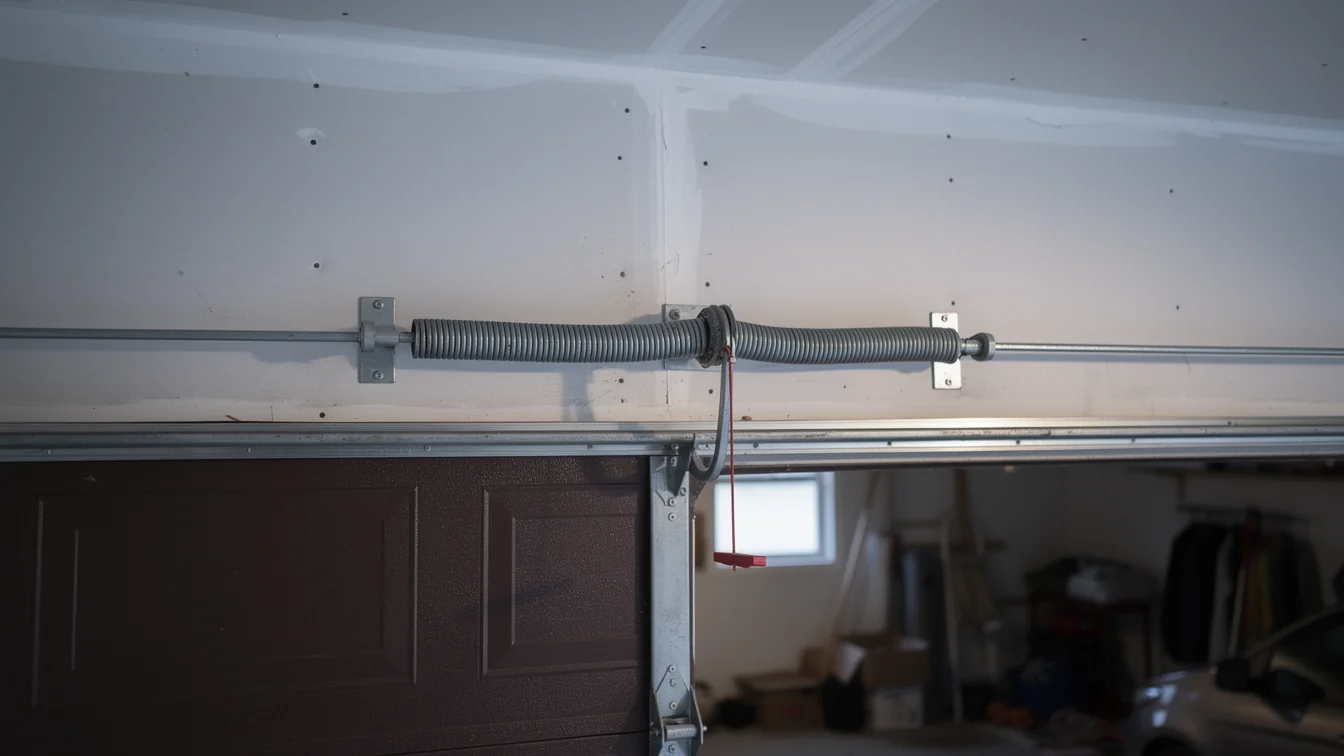
Before you call anyone, a quick look tells you a lot. Pull the emergency release and lift the door by hand - a properly balanced door should hold at about waist height on its own. If it drops like dead weight, the spring tension is gone. Look at the spring itself, usually mounted above the door on a shaft: a broken one shows a clean gap in the coil, sometimes with the two ends twisted apart. Rust along the coil is common on original 1980s and 90s installs that have never been serviced, and it's often the first sign of a spring getting close to failure before it actually breaks. Check the cables too - a broken spring sometimes takes a cable with it, and a frayed or slack cable on one side while the other is taut means the door is not safe to run. What we can't tell you from a checklist is the right spring size and wind for your door - that's measured on-site, not guessed over the phone.
What Local Conditions Do
This area sits in a cold moderate climate band, not the deep-freeze conditions some parts of the country deal with, but enough swing in overnight temperatures to matter for steel under constant tension. A spring doesn't need an extreme cold snap to fail - it needs a temperature drop layered on top of metal that was already fatigued from twenty or thirty years of daily cycling. With 11,832 owner-occupied houses here sitting on housing stock concentrated in that 1972-2003 build window, a lot of original springs are reaching that fatigue point around the same stretch of years, which is part of why these calls come in waves through the colder months rather than evenly spread across the year. It's less about any one bad night of weather and more about a whole generation of garage door hardware aging out together.
Frequently asked questions
Why do garage door springs break more in winter?
Cold makes steel contract, which adds stress to a spring that's already wound tight under tension. If the spring is old and fatigued from years of cycling, that extra contraction is often what finally breaks it. It's less about one cold night and more about age meeting weather.
My house was built in the 1980s or 90s - is the spring original?
It's possible. A lot of homes in this area date from that build window, and if the spring has never been replaced, it could be pushing thirty to forty years of use. Rust on the coil or a door that doesn't hold its position when lifted by hand are signs it's near the end.
Can I replace a torsion spring myself?
We don't recommend it. Torsion springs are under heavy tension and the tools and technique to wind them safely aren't something most homeowners have on hand. A mis-set spring can cause real injury. This is one job where calling it in is worth the cost.
Is it ever better to replace the whole door instead of just the spring?
Sometimes. If the door itself is original to a 1970s-80s build and the panels, track, or hardware are worn along with the spring, putting a new spring on an otherwise tired door can be a short-term fix. We'll tell you honestly if that's the case rather than just swap the part.
Related garage door services in Conway
More garage door guides
Book garage door service in Conway
Call now or request a quote - tell us what the door is doing and where you are.